
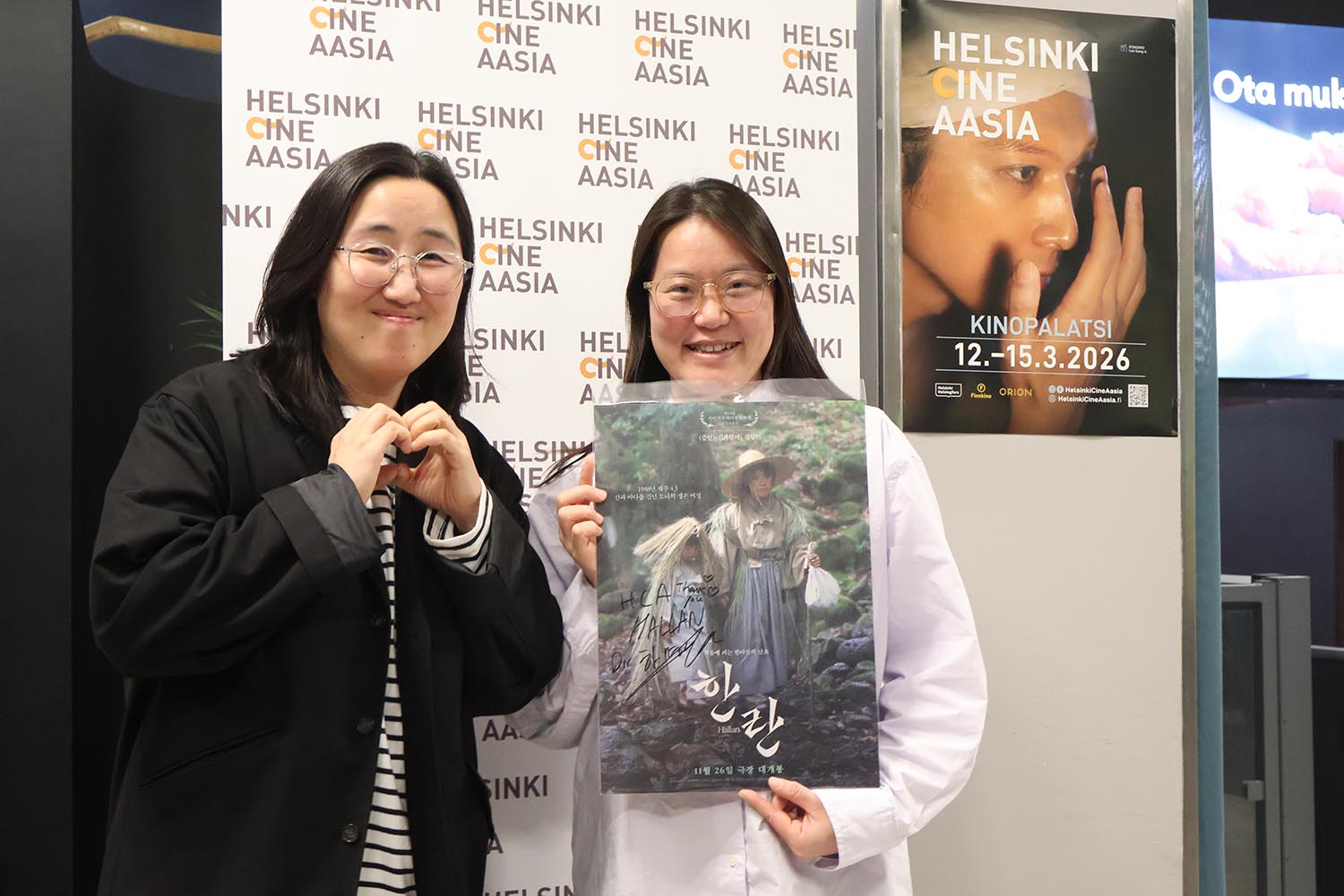
Photo: Tomi Rantanen
This year, the Helsinki Cine Aasia Film Festival had the honor of welcoming guests from South Korea: film director Ha Myungmi and producer Yang Younghee, who came to present their new film, Hallan (2025). Our festival reporter, Viktoria Murskaja, sat down with them to discuss their latest ground-making work, which sheds light on a silenced history of Jeju Island.
Director Ha, producer Yang, it’s a pleasure to meet you. How has your time in Finland and at the festival been?
Ha Myungmi: It’s my first time here, and I really like it. The atmosphere reminds me of Jeju Island, so it feels a bit like home. The fresh air, fresh water, and closeness to nature are very similar to Korea – of course, Jeju rather than Seoul.
People in mainland Korea sometimes think Jeju locals are quiet or have a moody face, but they’re actually very kind and warm-hearted. I feel a similar warmth from the Finnish friends I’ve met here. Sometimes think that Jeju is like the Korean Hawaii, but in winter it’s really cold, and there can be heavy snow and wind.
Yang Younghee: There’s a very cozy atmosphere among the audience and the festival staff. I feel that the audience is very sincere. They have a deep interest in other cultures and really try to communicate and learn. This creates a very positive energy. I hope that more people discover this festival, and next year, even more will attend.
Hallan is a film about the Jeju Massacre, which took place on April 3, 1948, when a large portion of Jeju’s population was killed after being labeled communist rebels by the government. Towards the end of the film, there is a touching scene in which a mother tells her daughter that it is important to record history so it won’t be forgotten. Was this also a motivation for you as a filmmaker?
Ha: I moved to Jeju Island in 2013, and every April 3 Memorial Day I felt a deep sorrow. I always wanted to do something about it. So yes, although the characters are fictional, the events are real. I wanted to make this film as a testament to history, and through the characters’ lines, to represent the lives of ordinary people and provide evidence of what truly happened.
Are there many films about the incident?
Ha: Not many. Hallan is actually the second feature film about this incident. There is another film done almost 13 years ago called Jiseul. ”Jiseul” means ”potato” in Jeju dialect. A local Jeju director made it on a very small budget with local actors. But that film didn’t really focus on soldiers or other armed groups, or the experiences of women and children.
When I made this film, I wanted to bring out those voices. In many historical films, women and children are sometimes portrayed simply as victims. I wanted them to be the main characters leading history, not just victims, and that was the main purpose of this film.
Until the 1990’s, it was illegal to talk about the April 3 events in South Korea. What about now? Is it taught in schools or openly discussed?
Ha: Compared to the past, this history is now being taught in schools. Before coming to Helsinki, I even had a screening for young students in Korea. Hallan also received a theatrical release, and over 30 000 people saw it. We can talk about the Jeju Uprising now, but it does not receive as much attention as the Gwangju Uprising of 1980. Many teachers still may not know the history in detail, because they themselves were never taught it.
Yang: We really want to reach the younger generations, so we have tried to promote the film in schools. The Jeju Island Office of Education has actually seen it and plans to show it to students.
Ha: When people try to research the events online, the information is often scattered and complicated. That’s why I wanted to simplify the history in my film, so it would be easier to grasp. Some storylines and characters became a bit flat or simple as a result, but it was the only way, for now, to make this complex history accessible. I hope that I have broken a taboo and many other filmmakers will continue to tell about it. I just wanted to break the silence.
Did you face many difficulties making a political film in Korea?
Ha: It was very difficult to make it. I had to fight with the fear of political judgement, and to keep my perspective, I had to make this film independently. It was really, really different to get a funding. Then I also had to fight with different audience opinions. But the main difficulty was still the emotional barrier. I had a very hard time making this film. It’s so sad. I’m not really a sad person, but once I started working on this, I cried every day.
Yang: In Korean society, although we have had many successful experiences of making our society more free and more democratic, we are still very weak. Like the whole situation with the former government [the 2022–2025 government under president Yoon Suk-yeol, who is now serving a life sentence]. The film industry is affected by the political situation and the society around. It’s not easy to make a film on this subject, and we were very shocked when Martial Law was declared. It’s the 21st century. How can dictatorship appear again?
It still impresses me that Korean cinema, even some very mainstream films, can be very openly critical of the government in a very dark way.
Ha: We have a DNA. The K-democracy DNA. Many Korean citizens are very brave and will do anything for the country and the democratic society. I have a huge respect for Korean citizens, and because of them, I could release this film. On the 3rd of December, when Martial Law was proclaimed, if no one would have fought, you probably wouldn’t have been able to see this film, and I might be in jail.
Yang: We were very scared.
It is great that you are now here, and safe. I have one final question: what’s next?
Ha: Last year, at the Bucheon International Fantastic Film Festival, I received an award that included price money for my next project. It is called LYNX, named after a Navy SEAL helicopter. I’m making a military horror thriller set in the contemporary times. My first feature film was a mystery crime thriller and I think nobody expected me to make a historical film. I’m going back to what I really love.
Thank you so much. I’ll be looking forward to it, and I hope you can come and visit Helsinki again one day.
Viktoria Murskaja